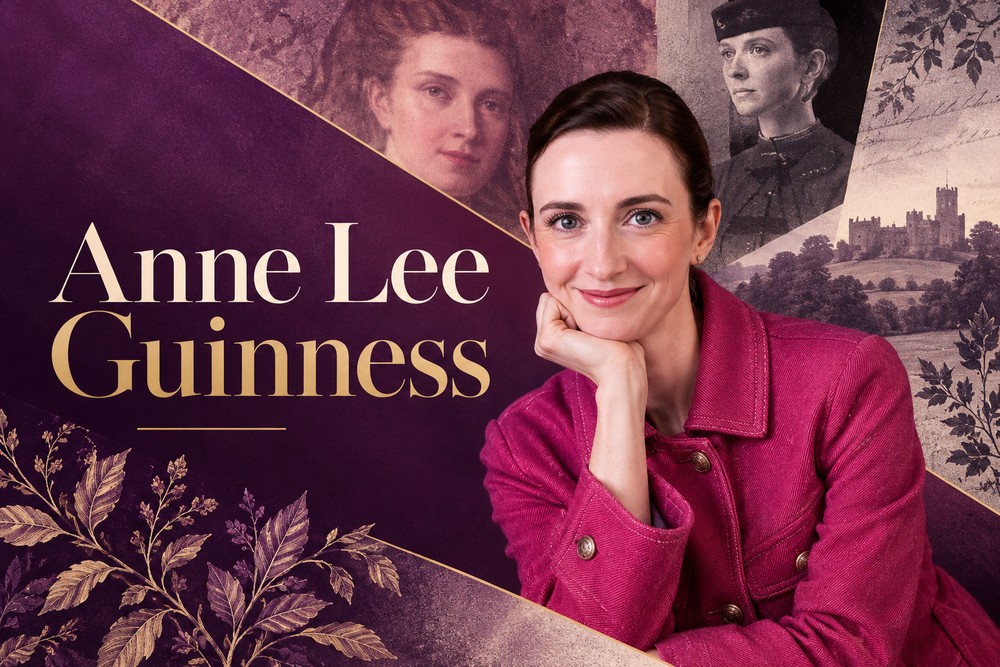
I begin with a date that stays with me: 8 November 1889. On that day Anne Lee Guinness died at Old Connaught House, near Bray, at the age of 50. Her life ran from 11 June 1839 to that autumn day, and within those fifty years she moved from Guinness daughter to Plunket wife, from private nurse to public benefactor, and from family circle to a memorial in stained glass.
A Life Shaped by Guinness and Plunket
Anne Lee Guinness was the only daughter of Sir Benjamin Lee Guinness and Elizabeth Guinness. Her father was a brewer and philanthropist, the third son of Arthur Guinness and Anne Lee. He restored St Patrick’s Cathedral, Dublin, a work completed in 1865 at a cost of more than £150,000, and he was made a baronet on 15 April 1867. His estate was £1,100,000. That fortune belonged to him, not to Anne, but it shaped the world in which she moved.
Her brothers were Arthur Edward Guinness, later Lord Ardilaun, and Edward Cecil Guinness, later the 1st Earl of Iveagh. A second brother, Benjamin Lee Guinness, lived from 1842 to 1900 and served in the Royal Horse Guards. He did not inherit the brewery, and I keep him distinct from Anne’s own son Benjamin, the future bishop. Family trees are rivers with bends, and this is one bend worth marking clearly.
On 11 June 1863 Anne married William Conyngham Plunket. He was born on 26 August 1828 and died on 1 April 1897. In 1871 he became the 4th Baron Plunket, so Anne became Baroness Plunket. If the birth day in the visitation record is right, the wedding fell on her twenty fourth birthday. I like that symmetry: a private life beginning on the same date as the public one.
William was the eldest son of John Plunket, 3rd Baron Plunket, and Charlotte Bushe. He was educated at Cheltenham and Trinity College, Dublin. He became Bishop of Meath in 1876, Archbishop of Dublin in 1884, and he served until his death in 1897. He died in Dublin and was buried at Mount Jerome. Anne had predeceased him.
Marriage and the Old Connaught Household
The marriage brought a dowry of £49,000. That money helped William extend Old Connaught House and restore its walled garden. I see the house as a stage for two public lives: his in the church, hers in nursing and education. The address is given as Old Connaught House, Dublin, in one place and Old Connaught House, Bray, in another. I treat these as the same house under different descriptions.
Anne’s husband inherited Old Connaught in 1871. His career moved through Meath and Dublin, and Anne moved with it. She was not a passive passenger. Her philanthropy grew from the streets around St Patrick’s Cathedral, where her father’s restoration work brought her face to face with poverty and sickness. That encounter became a quiet engine in her life.
The Work of Mercy
During the cathedral restoration Anne became involved with the poor and sick in the surrounding district. She sponsored Bible readings and basic medical provision. That small work grew into St Patrick’s Nursing Home, opened in 1876 and described as an important training centre for Church of Ireland nurses. Her husband supported the nursing home, and she in turn assisted his educational projects. I prefer that wording because the projects were his, and her support was real but secondary in that sphere.
She helped with the extension of Alexandra College and with the establishment of the Irish Clergy Daughters’ School at Earlsfort Terrace, Dublin. Her public memorial is not a single building but a network: a nurse trained, a student taught, a patient cared for. I think of her philanthropy as a lamp passed from hand to hand rather than a monument fixed in stone.
For much of her life she suffered from a degenerative illness. I have not found the name of that illness, and I do not invent one. She died on 8 November 1889 at Old Connaught House and was buried in the Guinness family vault at Mount Jerome Cemetery. In St Patrick’s Cathedral a series of stained glass windows depicts the works of Dorcas, also called Tabitha, the helper of the poor. That choice of subject tells us how her family wished her to be remembered.
Children and Their Legacies
Anne and William had two sons and four daughters. I set out the family in a table because dates and generations matter here.
| Name | Dates and notes |
|---|---|
| William Lee Plunket, 5th Baron Plunket | 19 December 1864 to 24 January 1920. Diplomat and Governor of New Zealand from 20 June 1904 to 8 June 1910. Married Lady Victoria Alexandrina Hamilton-Temple-Blackwood on 4 June 1894 in Paris. They had eight children, three sons and five daughters. |
| Elizabeth Charlotte Plunket | Daughter. Birth and death dates not established here. |
| Benjamin John Plunket | 1 August 1870 to 26 January 1947. Church of Ireland bishop. Married Dorothea Hester Butler, with a date conflict of 1900 or 1904. They had two sons and two daughters. |
| Olivia Anne Plunket | Daughter. Birth and death dates not established here. |
| Kathleen Louisa Plunket | Daughter. Birth and death dates not established here. |
| Ethel Josephine Plunket | Daughter. Birth and death dates not established here. |
William Lee Plunket was educated at Harrow and Trinity College, Dublin. He served as an attaché in Rome in 1889 and Constantinople in 1892. His honours included CVO, KCVO, KCMG, GCMG, and KBE. His wife Victoria gave her name to New Zealand’s Plunket Society. Their son Terence Conyngham Plunket, 6th Baron Plunket, was born on 12 July 1899 and died on 24 February 1938. He was Anne’s grandson, not her son. He married Dorothée Mabel Lewis, widow of Captain Jack Barnato, on 4 December 1922.
Benjamin John Plunket was curate, rector of Aghade, vicar of St Ann’s, Dublin, Bishop of Tuam, Killala and Achonry from 1913 to 1919, and Bishop of Meath from 1919 to 1925. He resigned on health grounds. One account calls him a churchman of broad views who was not afraid to utter his opinions. He inherited the childless Lord Ardilaun’s estate at St Anne’s, Clontarf. His daughter Olive Plunket, born in 1911 and died in 1975, married in 1933 Peter Wentworth-Fitzwilliam, 8th Earl Fitzwilliam. Olive was Anne’s granddaughter.
Later Generations and Corrected Relationships
I keep the generations straight because errors creep in easily. Terence Plunket, 6th Baron Plunket, was the son of the 5th Baron and Lady Victoria, so he was Anne’s grandson. His sons were Patrick Terence William Span Plunket, 7th Baron, born 8 September 1923 and died in 1975; Robin Rathmore Plunket, 8th Baron, born 3 December 1925 and died 16 November 2013; and the Honourable Shaun Albert Frederick Sheridan Plunket, born 5 April 1931 and died 10 January 2012. Patrick was Equerry to King George VI and Queen Elizabeth II. He was Anne’s great grandson, not her grandson.
Brinsley Sheridan Bushe Plunket is also a grandson, not a son. He was born on 28 June 1903 and died in 1941. He was the second son of William Lee Plunket, the 5th Baron. He married Aileen Sibell Mary Guinness in 1927, and they divorced in 1940. Aileen lived from 16 May 1904 to 31 March 1999. She was one of the Guinness Golden Girls, alongside Maureen and Oonagh, and she was a daughter of the Honourable Ernest Guinness, a granddaughter of the 1st Earl of Iveagh. These connections make a dense web, and I treat each relationship as a thread that must be tied at the right knot.
A Public Memory
Anne’s public memory rests on St Patrick’s Nursing Home. A later account already treated the home as the lasting public memorial of her philanthropy. I find that fitting. A training centre multiplies care through every nurse who passes through it. Her stained glass memorial in St Patrick’s Cathedral gives that work a visual shape: Dorcas, the helper of the poor, in coloured glass above the worshippers. In the Netflix series House of Guinness, Anne is portrayed by the English actress Emily Fairn. That is a later dramatisation, not a biographical record, but it shows that her story still has a public life.
FAQ
Who was Anne Lee Guinness?
Anne Lee Guinness was an Irish philanthropist born on 11 June 1839 and died on 8 November 1889. She was the only daughter of Sir Benjamin Lee Guinness and Elizabeth Guinness. By marriage she became Anne Lee Plunket and, from 1871, Baroness Plunket.
When did Anne Lee Guinness marry William Conyngham Plunket?
She married William Conyngham Plunket on 11 June 1863. He later became the 4th Baron Plunket and Archbishop of Dublin. If her birth day is correct, the wedding took place on her twenty fourth birthday.
How many children did Anne Lee Guinness have?
She had two sons and four daughters. Her sons were William Lee Plunket, 5th Baron Plunket, and Benjamin John Plunket, a Church of Ireland bishop. Her daughters were Elizabeth Charlotte, Olivia Anne, Kathleen Louisa, and Ethel Josephine Plunket.
Why is St Patrick’s Nursing Home important?
St Patrick’s Nursing Home opened in 1876 and became an important training centre for Church of Ireland nurses. It grew from Anne’s work among the poor and sick near St Patrick’s Cathedral. It is the clearest public memorial of her philanthropy.
Was Terence Plunket her son or grandson?
Terence Conyngham Plunket, 6th Baron Plunket, was Anne’s grandson. He was the son of William Lee Plunket, the 5th Baron, and Lady Victoria Alexandrina Hamilton-Temple-Blackwood. A list that calls Terence her son is one generation out.
Was Brinsley Sheridan Bushe Plunket her son?
No. Brinsley Sheridan Bushe Plunket was Anne’s grandson. He was the second son of William Lee Plunket, the 5th Baron. He was born on 28 June 1903 and died in 1941.